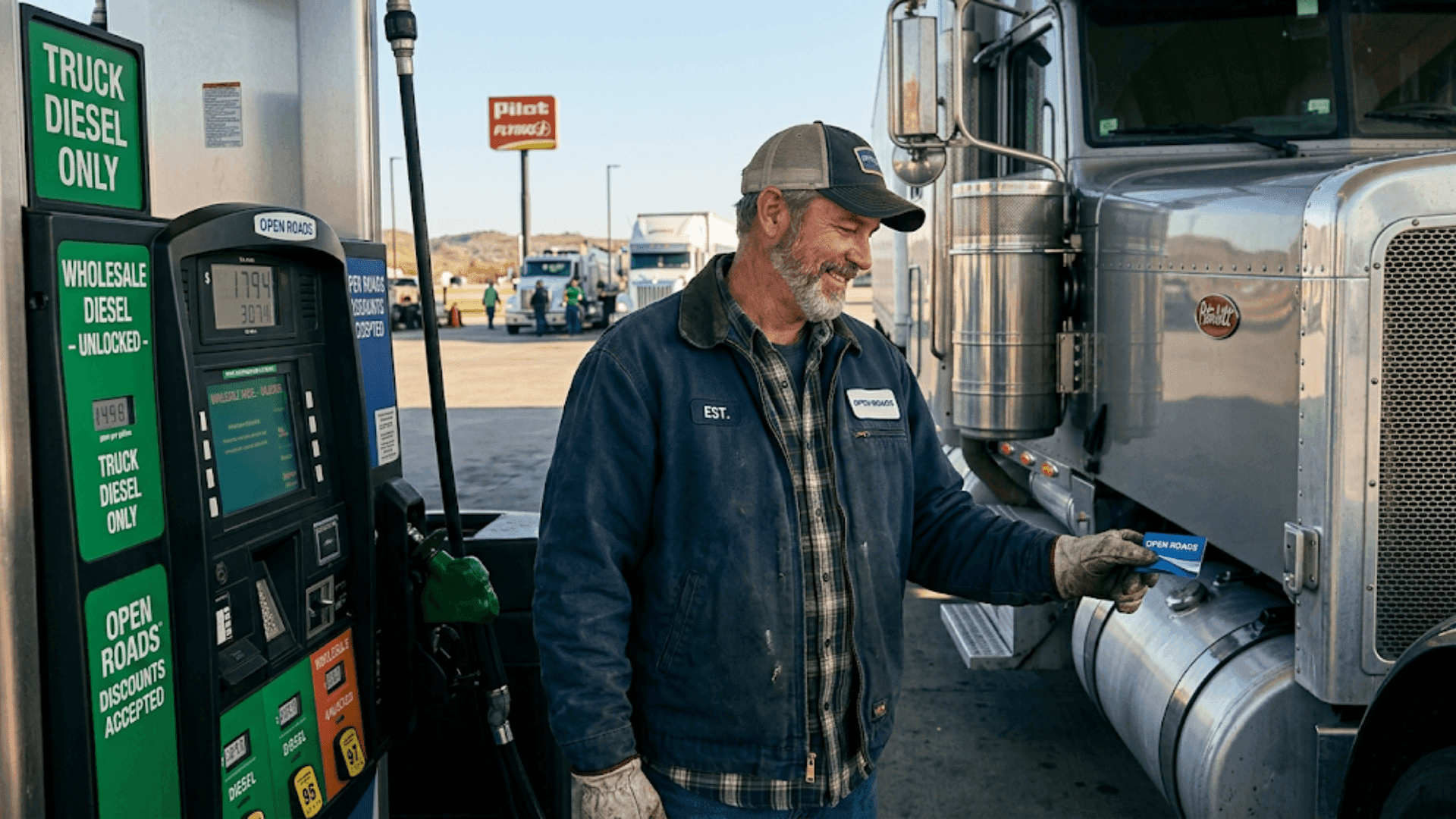
Diesel eats a huge share of your operating budget. If you run a small fleet or work as an owner-operator, every cent per gallon compounds fast. The open roads fuel card promises wholesale-style diesel discounts at the pump, plus app-based tracking so you can see what you actually save. This review breaks down how it works, where the money goes, and whether it fits a commercial diesel operation—not a weekend trip.
You’ll get a clear look at mechanics, savings math, trade-offs versus traditional fleet cards, and the complaints that show up in real user discussions. Use it to decide if the program belongs in your wallet.
What Is the Open Roads Fuel Card?
The open roads fuel card is a commercial fuel discount program built for drivers and fleets that burn a lot of diesel. You fuel at participating locations, pay a discounted pump price in real time, and monitor usage in a mobile app. Program materials position typical diesel savings in the 40–50¢ per gallon range, aimed at cutting one of your largest variable costs without a complex rewards maze.
How Does the Open Roads Fuel Card Work?
You enroll, get card access, and use the card (or linked payment flow) at in-network diesel stops. The discount applies at purchase rather than as a slow rebate months later. That cash-flow timing matters when you’re filling multiple trucks every week.
After each fill, you can track fuel usage and savings in the Open Roads app. Fleet managers and owner-operators use that view to spot high-cost routes, compare stops, and confirm the discount actually posted. The TSD Open Roads app experience is the day-to-day control layer: locate fuel, review transactions, and keep a simple audit trail for your books.
Practical flow for your team:
- Confirm the stop is in network before you commit the truck.
- Fuel with the open roads fuel card at the pump.
- Verify the discounted total on the receipt and in the app.
- Export or review totals when you reconcile expenses.
You’re not inventing a new procurement process—you’re swapping retail diesel pricing for a discounted commercial rate where the network supports it.
Fee Structure and Savings Potential
Lead with the savings figure you can actually underwrite. OpenRoad’s fuel card overview cites an average savings of about $0.50 per gallon, with stronger discounts at some sites. Separate coverage of the program describes real-time diesel discounts of 40 to 50 cents per gallon. Those are the anchors for your ROI math.
Simple fleet math you can run today:
- 3 trucks × 400 gallons/week × $0.45 average discount ≈ $540 per week before fees
- Over a year, that’s material cash back into maintenance, insurance, or payroll
Fees are the other half of the story. Commercial fuel programs often recover cost through a share of savings, per-transaction charges, or both. Open Roads marketing stresses discount depth; you still need to read your agreement for how the provider is paid, what happens on out-of-network gallons, and whether reporting tools cost extra. Before you enroll, ask for a sample statement that shows gross discount, fees, and net savings per gallon. If the net doesn’t clear your hurdle rate on real routes, walk away.
Don’t model “best case only.” Stress-test with your actual lanes, idle time, and the share of gallons you can realistically put through the network. Savings only count when your drivers can hit participating pumps without long deadhead miles.
Pros and Cons of the Open Roads Card
Pros
- Meaningful diesel discount: Typical savings land around 40–50¢ per gallon, which scales with volume.
- Real-time price relief: Discounts hit at the pump, which helps cash flow versus delayed rebates.
- App visibility: You can monitor usage and savings in-app instead of waiting on monthly spreadsheets.
- Fleet-oriented positioning: The commercial product lane targets operators who treat fuel as a controllable line item, not a loyalty side quest.
Cons
- Network dependence: Your net savings collapse if preferred stops aren’t convenient for your lanes.
- Fee opacity until you read the contract: Discount headlines don’t equal net cost until fees are clear.
- Process change for drivers: Cards, apps, and “only fuel here” rules need coaching or you’ll leak gallons to retail.
- Not a full spend platform: If you need broad T&E controls, tolls, and maintenance on one rail, a traditional fleet card may still sit beside it.
For high-diesel businesses, the upside is concentrated and easy to measure. For mixed fleets with light fuel volume, the admin overhead may outweigh the cents per gallon.
How Does Open Roads Compare With Traditional Fleet Cards?
Traditional fleet cards (WEX-style, major-brand fleet products, and broad network cards) optimize for acceptance, controls, and reporting—PINs, merchant locks, driver-level limits, and integrated expense feeds. You often pay retail-ish fuel prices and earn rebates or points later.
Open Roads flips the emphasis toward pump-price diesel discounting inside its ecosystem. Fleet-card comparison write-ups describe Open Roads as leaning into a dedicated fuel network with tighter controls and stronger reporting relative to more flexible, fee-light apps. Competitors like Mudflap stress flexibility and low friction; Open Roads competes on discount depth and structured commercial tooling.
| Factor | Open Roads fuel card | Traditional fleet card |
|---|
| Primary value | Cents-off diesel at participating pumps | Broad acceptance + spend controls |
| When you benefit | High diesel volume on in-network routes | Mixed spend, strict policy enforcement |
| Cash-flow feel | Discount at purchase | Often rebate after the statement |
| Best fit | Owner-operators and small diesel fleets | Fleets needing one card for many expense types |
Many operators run a hybrid: Open Roads (or similar) for diesel lanes where the discount is proven, and a traditional fleet card for everything else. That keeps controls without leaving easy cents per gallon on the table.
Open Roads Fuel Card Reviews, Complaints, and User Experiences
Open roads fuel card reviews online split between “the math works” and “the network didn’t match my routes.” In forum threads, users comparing options often like paying at the pump with a clear discount when the stop is right—and get frustrated when they must reshape itineraries to chase participating locations. That pattern shows up in owner discussions that weigh Open Roads against app-based alternatives.
Complaints you’ll see repeated:
- Savings vary widely by geography and stop quality.
- Driver adoption slips without simple rules and receipts checks.
- Support or enrollment friction when something fails at the pump.
- Confusion when people mix consumer/RV messaging with commercial fleet needs.
None of that makes the product illegitimate; it means your lanes decide the outcome. Pull 30–60 days of fuel tickets, map them against the network you’re offered at signup, and only then trust the brochure averages. If you can’t place a high share of gallons in network, no app feature fixes the ROI.
Treat early months as a pilot: one division, a handful of trucks, weekly net-savings review. Expand only after the data holds.
Final Verdict: Is the Open Roads Fuel Card Worth It?
Yes—if diesel is a top operating cost and your trucks can hit participating pumps without expensive detours. The open roads fuel card is worth a serious look when ~40–50¢ per gallon discounts show up as net savings after fees on your real volume. Average savings near $0.50/gal are compelling for small fleets and owner-operators who live on diesel margins.
Skip or postpone it if your fuel is scattered across one-off retail stops, your volume is light, or you need a single card to police every expense category. In those cases, a traditional fleet card—or a flexible competitor—may fit better.
Next step: Request current network coverage for your top corridors, a sample fee schedule, and a pilot on your highest-gallon trucks. Reconcile app totals against receipts for a full billing cycle. If net cents per gallon clear your target, roll it out with clear driver rules. If they don’t, you’ve lost little and kept your fuel program honest.
Sources
- Open Roads: Commercial Fuel Savings & Fleet Fuel Card ... — https://myopenroads.com/
- Open Roads: Fuel Discounts Built for RV Travelers — https://myfinancingusa.com/resources/open-roads-fuel-discounts-built-for-rv-travelers
- Exclusive Fuel Savings | OpenRoad Financial Services — https://openroad.inc/financial-services/fuel-card
- Mudflap vs. Open Roads: Fleet Fuel Card Comparison Guide [2026] — https://pfleet.com/blog/mudflap-vs-open-roads